WS10 Human–AI Interaction for Effective Learning Environments
This half-day mini-conference brings together theory, design, and
implementation research on Human–AI Interaction (HAI) for learning.
Format: Mini-conference with paper presentations
·
Length: Approximately 3.5 hours
·
Expected attendance: 15–25 participants
About the Workshop
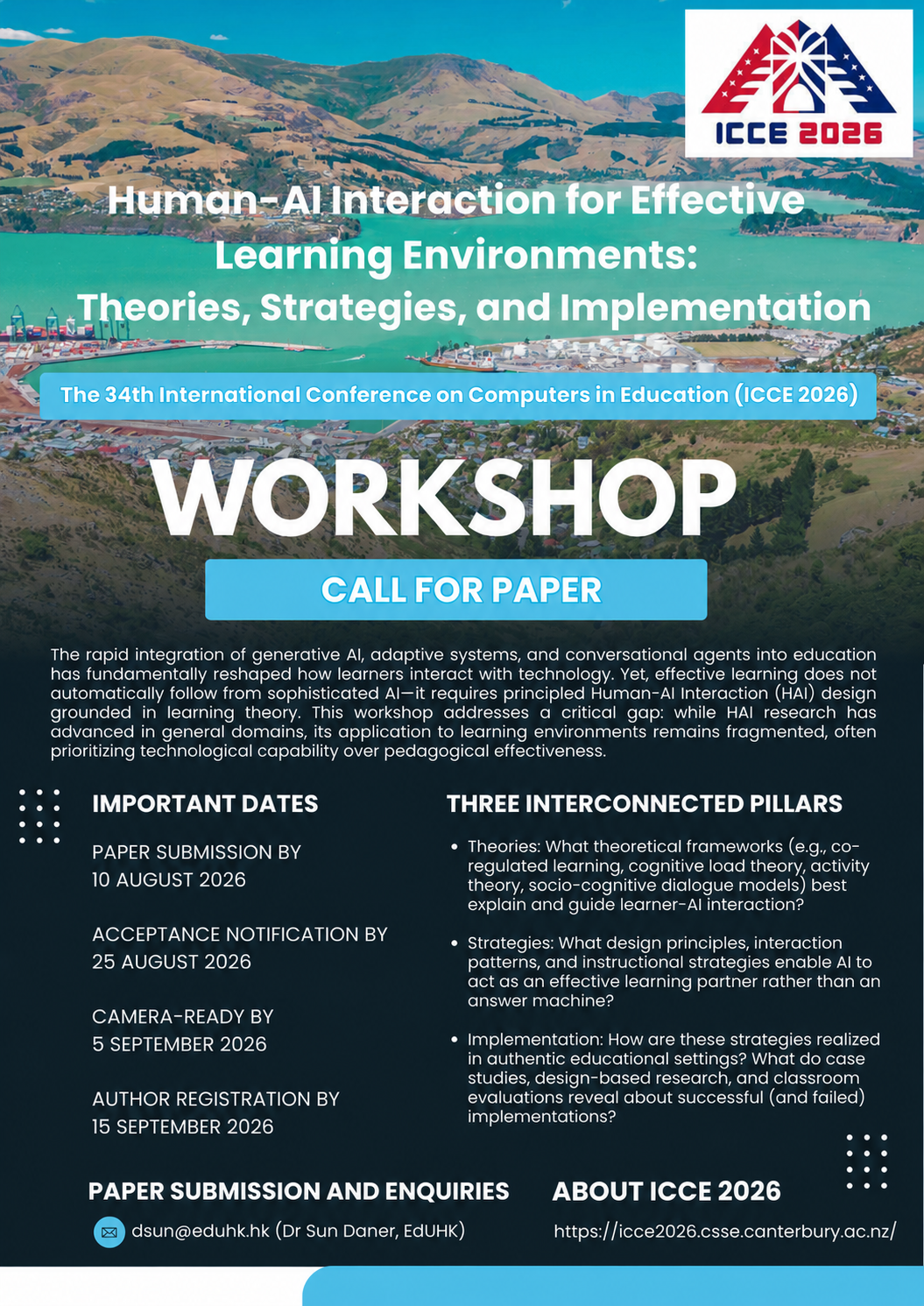
The rapid integration of generative AI, adaptive systems, and
conversational agents into education has fundamentally reshaped how
learners interact with technology. Yet effective learning does not
automatically follow from sophisticated AI—it requires principled
Human–AI Interaction design grounded in learning theory.
This workshop addresses a critical gap: while HAI research has
advanced in general domains, its application to learning environments
remains fragmented, often prioritizing technological capability over
pedagogical effectiveness.
Three Interconnected Pillars
-
Theories: What theoretical frameworks—including
co-regulated learning, cognitive load theory, activity theory, and
socio-cognitive dialogue models—best explain and guide learner–AI
interaction?
-
Strategies: What design principles, interaction
patterns, and instructional strategies enable AI to act as an
effective learning partner rather than an answer machine?
-
Implementation: How are these strategies realized
in authentic educational settings, and what do case studies,
design-based research, and classroom evaluations reveal about
successful and unsuccessful implementations?
Call for Workshop Papers
We invite theoretical, empirical, and design-oriented research on
Human–AI interaction in learning contexts. Topics include, but are not
limited to:
-
Theoretical models of learner–AI dialogue, co-regulation, and
shared metacognition
-
Empirical studies of AI tutoring systems, conversational agents,
and adaptive feedback
-
Design principles for explainable AI (XAI) and learner agency
-
Prompt engineering and interaction patterns for generative AI in
learning
-
Classroom implementation case studies, including successes,
failures, and lessons learned
- Teacher–AI collaboration and orchestration strategies
-
Cognitive load, motivation, and affect in human–AI learning
partnerships
-
Ethical issues including bias, over-reliance, transparency, and
data privacy
-
Evaluation frameworks for HAI in learning beyond generic usability
-
Embodied and voice-based Human–AI interaction for learning
-
Human–AI interaction for collaborative learning and group
regulation
Submission and Review
-
Submission format: Use the official ICCE workshop
paper template. Authors’ last names should be fully capitalized,
and abstracts should be under 350 words.
-
Review: Each paper will be peer reviewed by at
least two program committee members.
-
Submission email:
dsun@eduhk.hk
-
Presentation: At least one author of each accepted
paper must register by September 15, 2026, and present in person.
Accepted papers will be included in the ICCE 2026 workshop
proceedings, which are planned for submission to Elsevier for
inclusion in Scopus.
Important Dates
-
Paper submission deadline:
August 10, 2026
-
Acceptance notification:
August 25, 2026
-
Camera-ready deadline:
September 5, 2026
-
Author registration deadline:
September 15, 2026
-
Workshop date:
To be announced; half-day session during ICCE 2026
At least one author per accepted paper must register by September 15,
2026, to ensure inclusion in the workshop proceedings.
Proposed Half-Day Program
The workshop is planned as a 3.5-hour mini-conference. The schedule
below is provisional and will be updated after paper decisions.
Workshop Organizers
Dr. Sun Daner
Department of Mathematics and Information Technology, The
Education University of Hong Kong (EdUHK), Hong Kong SAR
Associate Co-Director, Global Institute for Emerging Technologies
(GIET), EdUHK
dsun@eduhk.hk
Dr. Sun is an Associate Professor and Associate Head at EdUHK, and
Associate Co-Director of GIET. Her research focuses on AI in
education, emerging technologies in education, mobile learning,
science education, technology-enhanced STEM education, and
higher-order thinking.
Dr. Grace Yue Qi
School of Humanities, Media and Creative Communication, Massey
University, New Zealand
G.Qi@massey.ac.nz
Dr. Qi is a Senior Lecturer and Doctoral Supervisor. Her research
explores the intersections of language, culture, and technology,
with interests in language teacher agency, professional
development, intercultural communication, diversity,
multilingualism, equity, and social justice.
Dr. Wen Yun
National Institute of Education, Nanyang Technological University,
Singapore
yun.wen@nie.edu.sg
Dr. Wen is a Learning Sciences researcher advancing
technology-enhanced learning innovations in schools. Her work
examines interaction and conversation in multimodal learning
environments using technologies including augmented reality and
artificial intelligence.
Dr. Xiaoyan Li
Center for the Promotion of Interdisciplinary Education and
Innovation, Kyushu University, Japan
lixiaoyan@kyoso.kyushu-u.ac.jp
Dr. Li is an Associate Professor at Kyushu University. Her research
explores language and culture as dynamic knowledge in multicultural
and interdisciplinary educational contexts, including the use of
educational chatbots and conversational AI for language and
cultural learning.
Prospective Program Committee
- Dr. Jining Han, Southwest University, China
-
Dr. Ying Zhan, The Education University of Hong Kong, Hong Kong SAR
-
Dr. Huiyan Ye, The Education University of Hong Kong, Hong Kong SAR
- Dr. Min Lan, Zhejiang Normal University, China
-
Dr. Zhizi Zheng, The Education University of Hong Kong, Hong Kong
SAR
- Dr. Huiying Cai, Jiangnan University, China
- Dr. Yuqin Yang, Central China Normal University, China
- Dr. Cixiao Wang, Beijing Normal University, China